
If your Indeed campaign budget used to last the month and now runs out in a week, or overnight, you are not imagining it. Indeed has changed how it paces spend inside a sponsored campaign. Instead of letting a few strong jobs absorb most of the money, it now spreads the budget across every active job in the campaign each day. For campaigns with many jobs and a modest budget, that means the money is spent faster and the jobs stop being sponsored early. This page explains what changed, what recruiters are reporting, and what a health system can do about it.
What Indeed changed
Indeed's help article on campaign pacing describes the new behavior plainly: "Indeed distributes your budget across all active jobs in your campaign on a daily basis." It also states the consequence: "campaigns with a lower budget may reach their limit sooner than the scheduled end date." When that happens, "your jobs will stop being sponsored until the next billing cycle or until you add more budget."
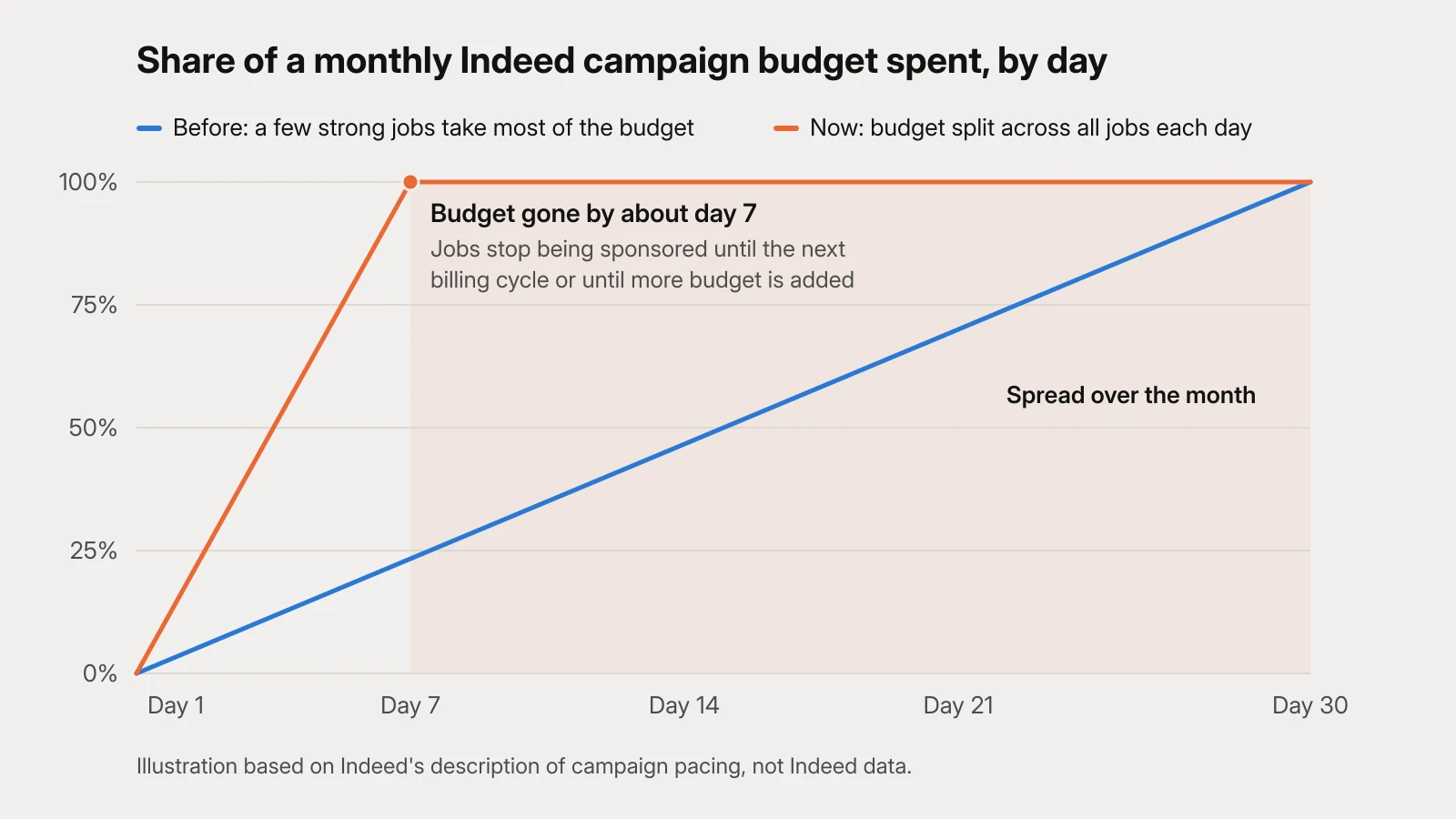
Indeed's position on cost is equally clear:
- No overspend. "Your campaign will never exceed the budget you set."
- Same prices. Cost per click and cost per application are "not affected by pacing."
- Not every campaign. "Most campaigns will not be noticeably affected." The ones that are have "a large number of jobs relative to your budget."
- No action required. "You aren't required to make any changes." Indeed does show a recommended budget at setup, which it says is there "to help extend the length of your campaign", and an estimated active days indicator on the dashboard.
Recruiters report that their Indeed reps placed the rollout in November 2026, and that some accounts saw it from September. Separately, Indeed's budget article notes that a daily budget is an average, not a hard daily cap: "Daily spend may go above or below your set amount. However, it will never exceed the overall maximum for your plan period." On a continuous plan that maximum is 7.5 times the daily budget per week.
Why it feels like your budget was spent without you
Technically nothing is charged beyond the cap. But a budget sized to keep thirty requisitions visible all month now buys a few days of visibility for all thirty, and then none. Two earlier changes make this sting more. Indeed has been reducing free visibility for unsponsored jobs since early 2026; it told ERE that "organic visibility for free jobs is not guaranteed nor will it be consistent over time." So when sponsorship ends mid-month, many jobs effectively disappear from search until someone adds money. And the recommended budget at setup is often far above what the team planned to spend.
What recruiters are reporting
Recruiting forums have been full of the same story since late summer. A few representative accounts from r/recruiting, August to October 2026, paraphrased:
- A recruiter at a large rural health system that hires 200 to 300 people a month said it once spent $20,000 a month on Indeed, has cut that by more than half, and still struggles to see its open jobs in search, sponsored or not.
- A mid-sized employer's monthly, balanced-budget campaign for its lower-spend jobs spent the whole month's budget overnight.
- A small staffing firm that had spent $500 to $800 a month for years saw its budget gone in six days; it added 50% more and that was spent in a day. Its new campaign setup recommended about $21,900 a month for eight entry-level jobs.
- A restaurant group with 60+ locations went from about $5,000 a month to $7,500 or more for the same or worse results, and said its campaigns now "try to spend out your budget as fast as possible."
- Several recruiters who raised daily budgets got more applications but not better ones, and went back to $20 to $35 a day.
These are individual reports, not a survey, and Indeed says most campaigns are unaffected. But the pattern matches the mechanism Indeed describes: the teams hurting most run many requisitions on a fixed budget. That describes most hospital and health system talent acquisition teams.
What to do about it
None of this requires leaving Indeed. It requires treating sponsored spend as one channel with a ceiling, not the default for every requisition.
- Check the estimated active days on every campaign. If a monthly campaign shows a week, you are in the affected group. Decide now whether that is acceptable instead of finding out on day eight.
- Stop spreading a small budget over many jobs. Pacing divides the budget across every active job in a campaign, so a campaign holding forty requisitions on a forty-job budget is the worst case. Split campaigns by priority, and keep hard-to-fill roles (night-shift ICU, OR, rural sites) in a campaign funded to last.
- Sponsor the requisitions that stall, not all of them. Roles that fill from your careers site, referrals and returning staff do not need paid clicks. Sponsor after a role has gone a set number of days without qualified applicants.
- Measure cost per qualified applicant and per hire, not per click. More applications at a higher budget is not a win if the qualified share falls. Track which campaigns produce hires, and move money accordingly.
- Re-engage the people already in your ATS. Past applicants, silver medalists, former employees and per diem staff already chose you once. Contacting them costs nothing per click. The obstacle is usually stale contact data and the time it takes to reread old applications against a new role.
- Source licensed clinicians directly. Most nurses and therapists who could fill a role are employed and not searching job boards at all. Reaching them one to one, from licensure data, does not depend on any job board's auction. Our guide to sourcing passive nurse candidates covers the method step by step.
- Keep a listing that does not run out. A job that disappears from search the day a campaign budget is spent still needs to be findable. Publish every open role somewhere that keeps it listed until you close it: your own careers site and healthcare-specific job boards.
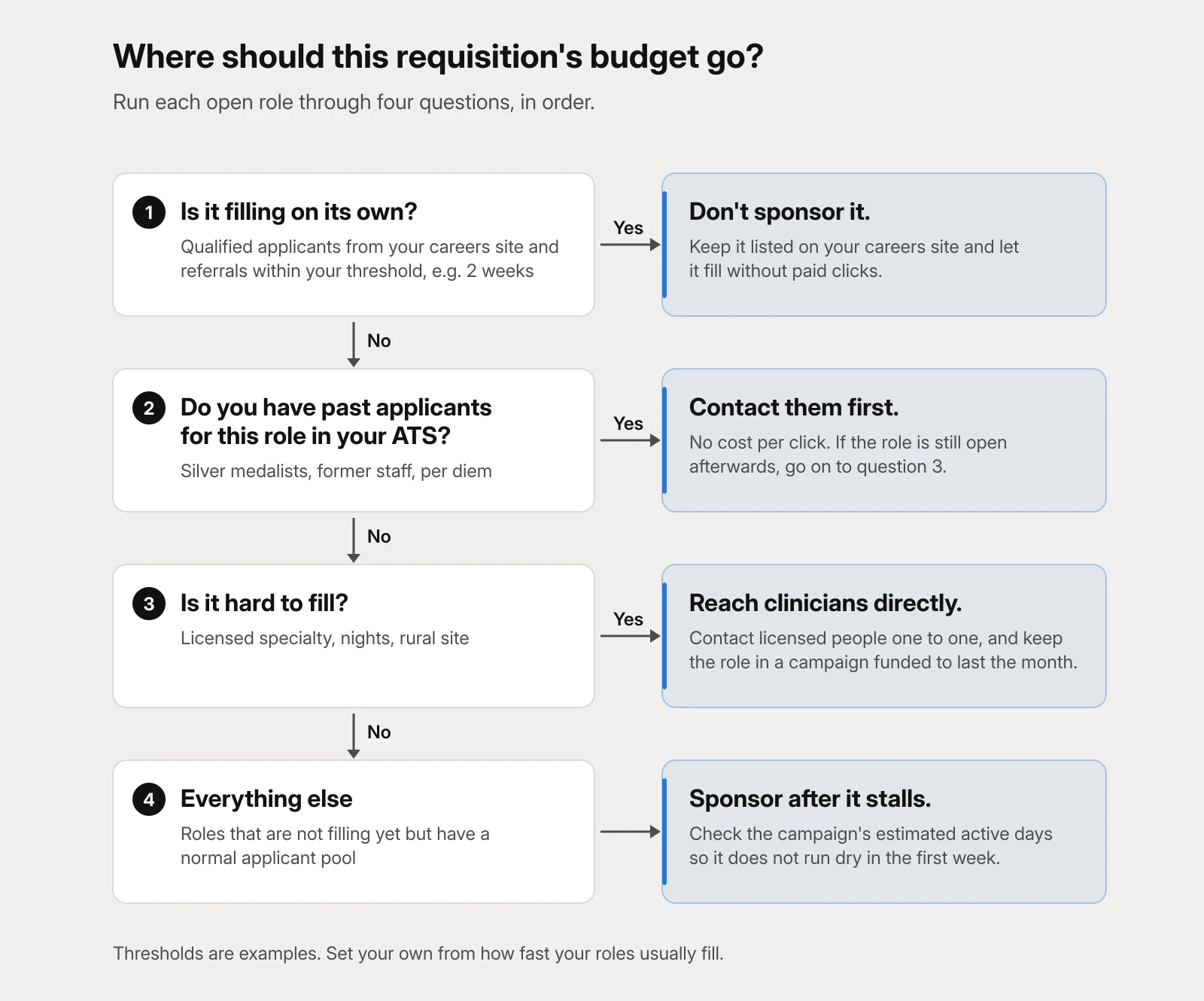
To put the steps to work, run each open requisition through the four questions below at the start of the month.
Where Betterleap fits
Betterleap helps with steps 5 to 7: it resurfaces past applicants from 25+ applicant tracking systems, finds licensed clinicians among 35M+ healthcare professionals and contacts them from the recruiter's own mailbox, and lists customers' open roles on its healthcare job board until they close. If that would help your team, request a demo.
Sources
- Indeed Employer Help Center, How campaign spend is paced, read 12 November 2026.
- Indeed Employer Help Center, Managing Sponsored Job Budgets, read 12 November 2026.
- ERE, Indeed Is Cutting Visibility for Free Job Postings.
- Public discussions in the r/recruiting community, August to October 2026.
Frequently asked questions
Why did my Indeed budget run out early?
Indeed now distributes a campaign's budget across all of its active jobs every day. Campaigns with many jobs relative to their budget reach the limit before the scheduled end date, and their jobs stop being sponsored until the next billing cycle or until more budget is added.
Is Indeed charging more than my budget?
No. Indeed states that a campaign will never exceed the budget you set, and that cost per click and cost per application are not affected by pacing. The change is in how fast the budget is spent, not in the total.
Do I have to increase my Indeed budget?
No. Indeed says you are not required to make any changes. You can split campaigns so smaller budgets cover fewer jobs, sponsor only the requisitions that stall, and fill the rest from your ATS, referrals and direct sourcing.
When did Indeed change campaign pacing?
Recruiters report that Indeed reps placed the rollout in November 2026, with some accounts affected from September 2026. Indeed's help article describes the behavior but does not give a date.
How can a health system reduce its Indeed spend without losing applicants?
Sponsor only hard-to-fill roles, measure cost per qualified applicant and per hire rather than per click, re-engage past applicants and silver medalists in your ATS, source licensed clinicians directly, and keep every open role listed on your careers site and on healthcare job boards such as Betterleap's. Those channels do not depend on a job board's pacing or auction.